 Amos Rimon


Key Takeaways
- Reinforcement learning in LLMs helps align model outputs with human preferences, thereby reducing the occurrence of harmful or inaccurate results.
- RLHF techniques, such as group relative policy optimization, offer scalable methods for fine-tuning LLMs using dynamic feedback.
- The synergy between RL agents and LLM agents is driving new findings in LLM reasoning and task adaptability.
Introduction

Synergy (Source)
In the field of artificial intelligence, two technologies are now recognized as significant advancements: Reinforcement Learning (RL) and Large Language Models (LLMs). Reinforcement learning, an approach that allows machines to learn from their interactions with the outside world, has completely changed how independent decision-making and adaptive behavior are achieved. At the same time, LLMs have natural language processing, increasing the abilities of tools such as conversational agents and machine translators to be more advanced and productive. In 2025, RL in LLMs is widely used to improve the behavior of these models in real-world settings. The combination of these two technologies has great potential, as RL can greatly improve the capabilities of LLMs, making them more flexible and better aligned with human values. RL agents learn from feedback and rewards, while LLM agents focus on generating and reasoning through language. When combined, they support robust LLM reasoning, which helps models to make better decisions and generate more useful responses. This synergy is more than just an abstract concept because it has been demonstrated previously in applications like ChatGPT. It accomplishes that through using RL, which helps LLMs to provide far more accurate and context-aware responses. In this blog post, the core concepts of RL and LLMs will be presented, including how these two methodologies function together.
RL and LLMs - in brief
Reinforcement learning, better known as RL, is an innovative artificial intelligence methodology focusing on understanding how agents need to act in a particular environment for maximum reward accumulation. The concept of “actions” relates to the set of all decisions that an agent can take. The agent needs to create a policy that maximizes the overall reward over time. Using this policy, the agent interacts with an external system known as the environment. These interactions enable the agent to get rewards for the assignments they have achieved. As observed by the agent, the environment might be present in a variety of states, representing the different scenarios or configurations that it can take.
In 2025, RL in LLMs is a common approach to make language models work better in real-world applications. It works by having the model (the agent) perform actions, such as generating answers, and then learning from those actions. The model learns to provide better answers over time by going through this process. This is a good time to compare RL agents and LLM agents. Real-world agents learn by making mistakes and learning from them. It is the job of an LLM agent to read and write text. When used together, the LLM agent improves its ability to think things through and learns how to use input to make better choices. This is called LLM thinking.
The main components of RL:
- Agent: the learner (this could be an LLM)
- Environment: where the agent acts (such as user prompts)
- Action: what agent does or responds to
- Reward: comments on how well that work was done
LLMs are designed to understand and produce human-like text by utilizing extensive datasets. Generating contextually appropriate and coherent text has transformed many applications, starting from systems for sophisticated translation to customer service chatbots. LLMs can produce text with very high accuracy that is also contextually aware. On the other hand, LLMs have some challenges. A phenomenon referred to as “hallucination” is one of the issues where models give inaccurate or nonsensical responses. Additionally, ethical issues can arise. These issues are reflected in inadvertently perpetuated biases that were present in their training data. RL can be employed to optimize LLMs, enhancing their capacity to make informed judgments by incorporating input from their interactions. This is especially beneficial in situations where LLMs must adjust to individual user preferences or continuously enhance themselves through real-world interactions. Although LLMs have significant capabilities in creating and comprehending language, there are instances where they may provide outputs that are seemingly plausible but ultimately inaccurate. Reinforcement learning in LLMs, which prioritizes maximizing long-term rewards by rating the quality of the language model’s output, may assist in reducing these mistakes by continuously improving the model’s outputs through feedback. Nevertheless, the process of integrating these elements is not without difficulties. In short, combining RL and LLMs allows us to build systems that can reason, adapt, and continuously improve. This is what makes LLM reasoning the primary trend in AI development in 2025.
LLM and RL synergy
LLM and RL synergy is popular among researchers and machine learning engineers because of the huge range of practical applications in separate frameworks. Also, there are a lot of studies that examine their intersection and joint computational framework. The categorization classifies all applications where LLM and RL agents collaborate in these methodologies and proposes the following RL/LLM categorization tree.

RL/LLM categorization tree (Source)
The part of the tree that belongs to the RL4LLM methodologies belongs to the group that wants to enhance LLM performance in an area of text summarization, conversation, or question answering. Here, the LLM is a component of an RL training pipeline. These applications can be divided into the ones which use RL to fine-tune the LLM. Obtaining satisfactory outputs is conducted by adjusting the model hyperparameters. This category can be split additionally on the methods that use use human feedback. The second subcategory involves algorithms that use RL to iterate and, in that way, update the LLM prompts in order to get the desired performance.
Within the second group, named LLM4RL, the LLM changes or helps one of the following essential components of the reinforcement learning agent: the reward function, the training goal, or the policy function. It comprises the applications where the goal is to enhance the training component or the control task efficiency and is split into LLM4RL-Reward, LLM4RL-Goal and LLM4RL-Value/Policy subclasses. LLM4RL-Reward-based applications use an LLM to design the reward function of the RL agent. The second one uses an LLM to set up goal settings. The last subclass, LLM4RL-Value/Policy subclasses, uses an LLM as a policy function which has to be trained.
Within the RL+LLM group of applications, LLMs arrange individual skills learned using RL. This class is separated into the methodologies that update the LLM prompt, and in the other ones, LLM prompts stay fixed, along with the planning process.
In the sequel, we are focusing on Reinforcement Learning from Human Feedback (RLHF) in combination with LLMs.
LLM and RLHF synergy
To address the mentioned problems, so-called Reinforcement Learning from Human Feedback (RLHF) techniques have been developed. The symbiosis with LLMs mainly consists of three elements: an already trained LLM that has to be aligned, a reward model that learns from human feedback, and an RL method that is used for LLM training. Already trained LLMs, which have to be aligned, are the ones that have existing pre-trained language model (LM) parameters, such as OpenAI’s GPT-3 with 175B or InstructGPT with 280B parameters. Using RLHF, the models are refined through feedback from human evaluators, who assess LLM outputs according to human preferences. The steps where the user’s prompts and outputs are collected are usually written by human labelers. The collected data can be related to some specific area or scenario, but it is crucial to ensure task diversity. The feedback loop facilitates the model’s alignment with human values and expectations, leading to outputs that are more accurate, reliable, and contextually appropriate. The alignment criteria are commonly accomplished by learning from the data collected from the responses to the users’ queries. Furthermore, the combination of RLHF and LLMs effectively tackles certain intrinsic constraints of both approaches. In this combination, the current state represents the prompt, together with the text already generated in past interactions that are provided to the model.

RLHF and LLMs (Source)
The LLM output is then evaluated by the reward model with a human in the loop to get the score on how the generated text fits the requested one. The reward models usually use a scalar value for scoring the human preferences of the LLM-generated text. It can be a novel LLM that learns on these preferences or fine-tuned LM where the number of parameters is commonly lower than the number used for LLMs to be aligned (for example, OpenAi uses 6B parameters for this purpose). The signal from the reward model is then used for LLM optimization, where a specific RL algorithm is applied. To train the reward model, an LM model is utilized to generate output texts by employing sampled prompts provided by humans or the supervised dataset. These paired results are annotated, often by ranking them following human preferences. The dataset is used for training the reward model to be capable of predicting the LLM action. The action will be the next tokens or the words the LLM generates based on the current prompt. The final goal is obtaining a policy under which the LLM gives highly scored outputs that match human preferences.
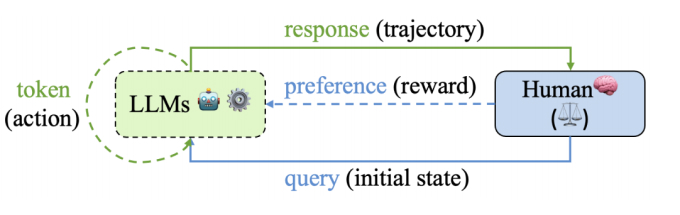
LLM and online RLHF (Source)
The user’s feedback on the LLM’s responses can be used in this manner, but it could be impractical for other applications because keeping humans in the loop online is expensive. To reduce costs, using an offline alignment dataset generated by human annotators can be more practical. This dataset contains different queries, responses, and human-generated preferences, which are then used for LLM alignment.

LLM and offline RLHF (Source)
Practical Applications
We will present three practical applications in different areas where RLHF is used to enhance LLM capabilities.
ChatGPT
The general RLHF and LLM combination presented above is applied to ChatGPT, and the next three steps are realized. First, the human annotators prepared the prompts and desired responses to train the model. After that, to design and train the reward model, the comparison data are created. These data consist of several pairs of prompts and answers that are ranked by the human annotators’ preferences. Using these ranked datasets, the reward model is then trained to rank the RL agent’s output without humans. In the last step, the RL policy produces outputs that are preferable, and this process is repeated until the RL agent attains preferable performance.

3-step ChatGPT training procedure (Source)
BioGPT
Within the healthcare industry, the collaboration between RL and LLMs is aimed at enhancing patient care and advancing medical research. LLM-powered virtual health aides offer patients dependable information and assistance. By incorporating RL, these assistants can enhance their capabilities by acquiring knowledge from patient interactions. This enables them to provide more precise guidance, arrange further appointments, and even anticipate prospective health concerns using user data and feedback. One of the representatives in the area of healthcare LLM systems is BioGPT-JSL, which allows clinicians to compile information related to the patient’s symptoms and inquire about medical conditions by asking simple health-related questions. This system can answer clinical questions characterized by diseases, tests, and drugs.

BioGPT-JSL demo (Source)
BloombergGPT
LLMs can be utilized by financial advisers and trading algorithms to analyze and comprehend huge amounts of financial data, market patterns, and news items. When augmented with RL, financial institutions fine-tune LLMs to recommend relevant products to customers and identify insights from financial data. For example, BloombergGPT is fine-tuned with specific domain data, making it one of the best-performing LLM models for the finance industry.
Future directions
More specialized models can provide accurate and relevant outputs for specific use cases. Future trends can be focused on controlling the LLM’s outputs to ensure they match the particular goals and defined constraints. This could be enhanced by introducing techniques like prompt engineering, which will steer model generation in the right direction. This is crucial in applications where safety, ethics, and accuracy are a must, such as the already mentioned finance, healthcare, or public policy areas.
In 2025, RL in LLMs is the core in guiding how models respond to complex tasks. It helps align LLMs with legal, ethical, and institutional rules. Using reward signals, developers can fine-tune LLMs to be safer and more reliable. LLM reasoning has been improved through dynamic feedback and policy learning. This helps models think step by step and gives more accurate answers in multi-agent environments. The difference between an RL agent and an LLM agent is also more important now. RL agents learn by interacting with environments, while LLM agents are trained to understand and respond to language. Together, they create more intelligent systems. RL also helps with few-shot and zero-shot learning by adjusting reward models to generalize better across tasks.
FAQs
1. How does reinforcement learning improve LLM performance?
Learning from input is an integral part of RL because it helps LLMs adapt and generate outputs that align with human goals. It improves accuracy and makes answers more helpful while lowering harmful ones.
2. How can RLHF mitigate hallucination issues in LLMs?
RLHF penalizes hallucinations and rewards outputs that are based on facts. This feedback process teaches the LLM to write more grounded text over time.
3. What is the reward model in RLHF, and how does it function?
Users’ choices determine how the reward model rates LLM products. Then, it guesses which answers people would rate higher and trains the LLM to do those things.
4. What are the main steps in the RLHF process for LLMs?
Gather information about people’s preferences and set up an award system. Then, based on the reward model’s recommendations, use RL to improve the LLM.


 Philip Tannor

 Yaron Friedman

